Exterior Concrete Coatings for Pool Decks, Driveways & Patios
A practical guide for St. George homeowners on choosing UV-stable, slip-resistant coatings that survive 110°F asphalt-temperature summers, harsh monsoon storms, and decades of foot traffic — without yellowing, peeling, or turning into a heat trap.
Why exterior concrete coatings are a different problem
The coating that works inside a garage will fail outside in Southern Utah within a single summer. Standard epoxies amber and chalk under UV. Smooth topcoats turn dangerously slick when wet. Dark colors absorb so much radiant heat that a pool deck becomes unwalkable by 10 a.m. An exterior system has to solve UV stability, slip resistance, and surface temperature at the same time — and bond to a slab that expands and contracts with 60-degree daily swings.
UV stability
Aliphatic polyaspartic topcoats stay clear and color-true under direct desert sun. Epoxy is aromatic — it yellows on day one.
Slip resistance
Broadcast aggregate or vinyl flake plus a textured topcoat keeps the coefficient of friction high when the deck is wet.
Thermal & impact
Light-reflective colors lower deck temperature; flexible polyaspartic absorbs slab movement instead of cracking with it.
Pool deck coatings
A pool deck is the hardest exterior surface to coat well. It's wet for hours every day, bare feet need traction without abrasion, chlorinated water attacks cheaper resins, and the surface has to stay cool enough to walk on at noon.
- Choose a light, reflective base color — tans, light grays, and bone tones cut radiant heat dramatically vs. dark gray or charcoal.
- Specify a broadcast vinyl flake or quartz aggregate followed by a textured polyaspartic topcoat for a high coefficient of friction when wet.
- Require chemical resistance to chlorine, bromine, and salt water — not all exterior systems are rated for pool chemistry.
- Insist on full mechanical prep (diamond grind) instead of acid etch. Etch leaves residual chlorides that block adhesion on a wet-cycled slab.
Driveway coatings
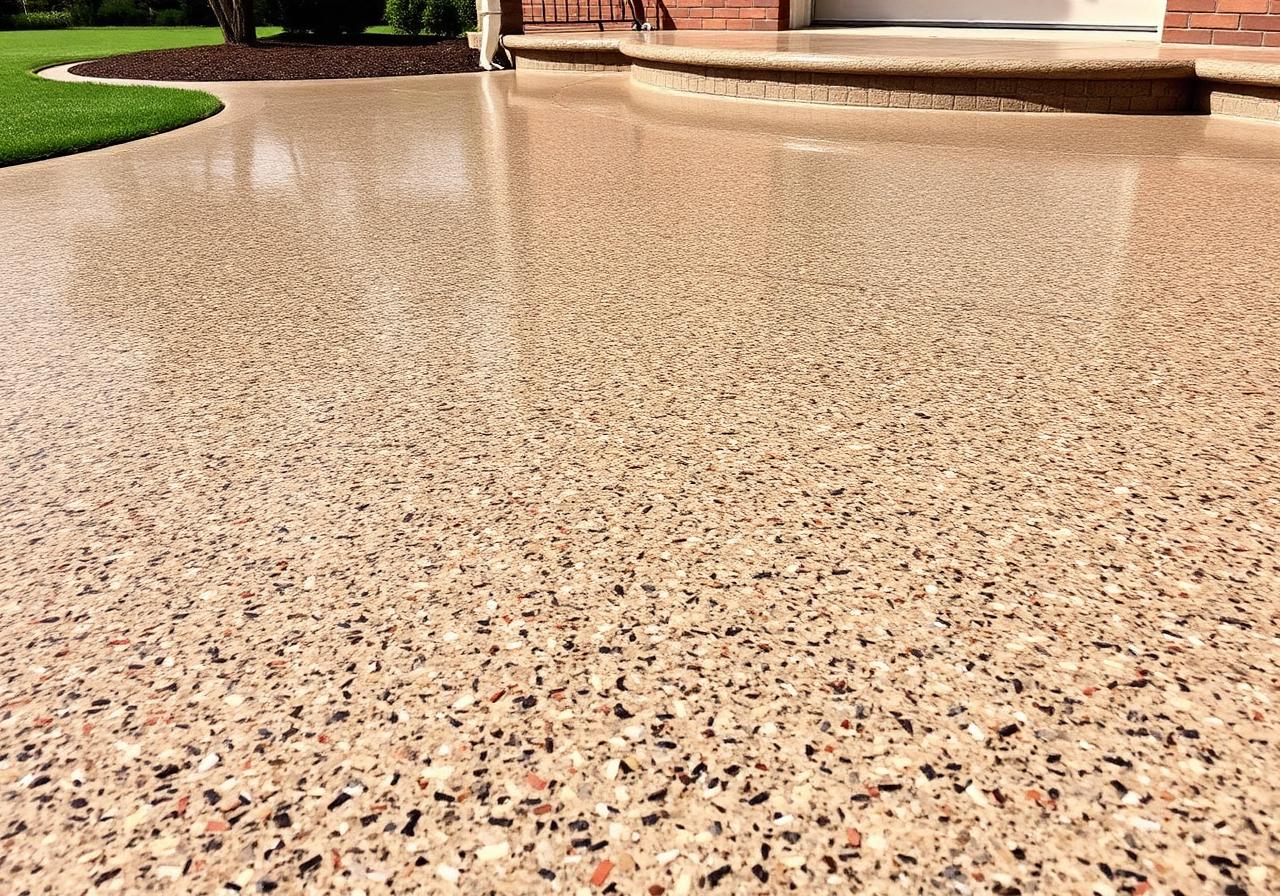
A residential driveway sees hot tires, oil drips, monsoon rain, and the same UV punishment as a pool deck — plus heavy point loads. The right system is a high-build polyaspartic over a flake or quartz base coat, ground into a properly profiled slab.
- Hot-tire pickup resistance — polyaspartic is the only resin family that consistently survives summer tire heat.
- Crack repair before coating, not after — exterior slabs telegraph movement into any topcoat.
- Slip-rated topcoat texture so wet rubber on a graded driveway is still safe.
- Joint detailing that lets the slab expand without tearing the film.
Patio & outdoor living coatings
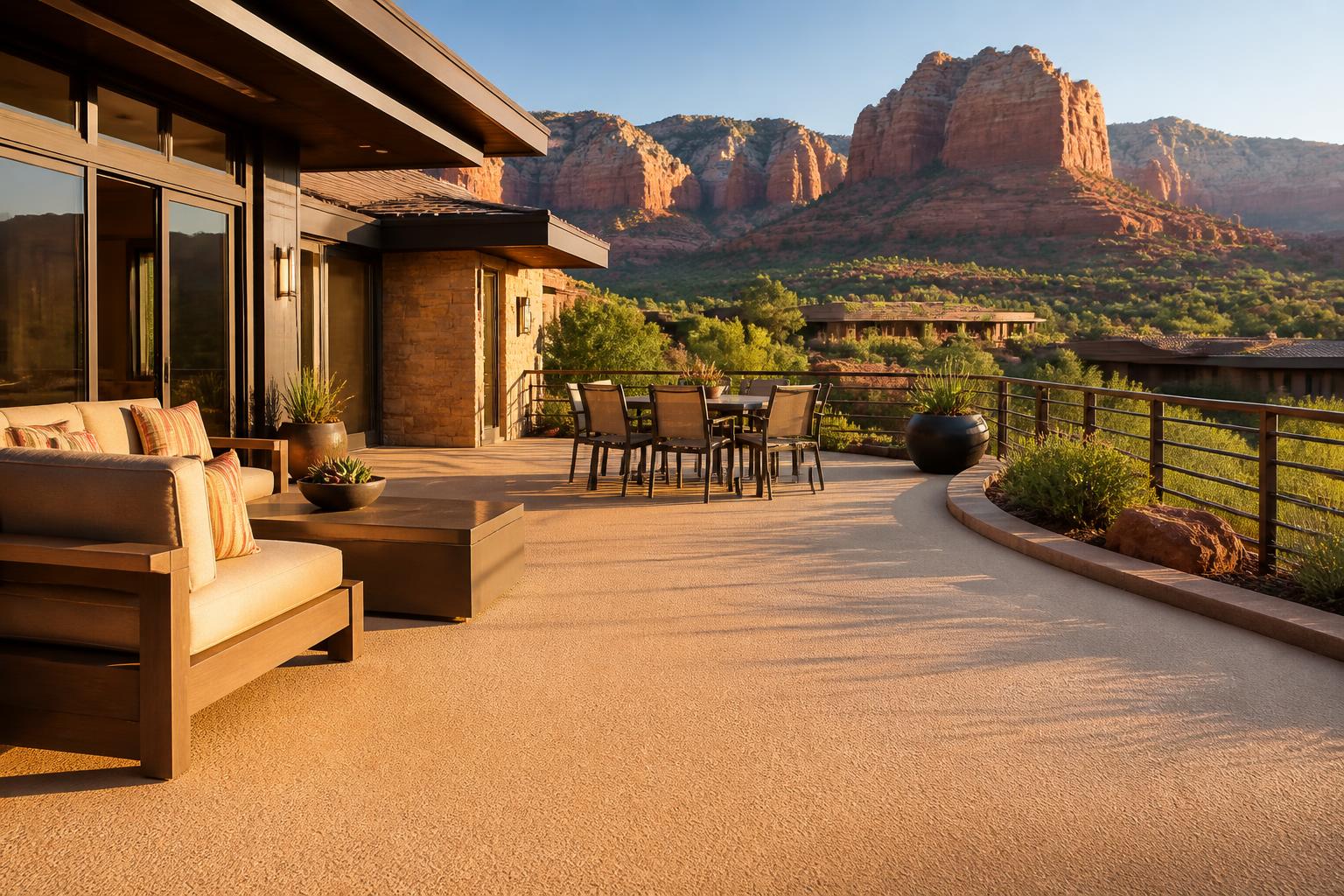
Patios are the easiest exterior surface to over-design and under-prep. The finished look matters — flake, quartz, or a solid polyaspartic — but the decisions that determine whether it lasts ten years are the same ones that apply to pool decks: aliphatic UV-stable resin, light reflective color, textured slip-rated topcoat, and a diamond-ground profile underneath.
The exterior installation process
- 1Diamond grind
Open the concrete profile to CSP-2/3 so the base coat penetrates instead of sitting on the surface.
- 2Repair
Fill cracks, divots, and spalls with a flexible polyurea patch designed to move with the slab.
- 3Base coat
Pigmented polyaspartic base coat in a light reflective color, applied at spec film thickness.
- 4Broadcast
Full broadcast of vinyl flake or quartz aggregate to refusal for slip resistance and visual depth.
- 5Topcoat
Aliphatic UV-stable polyaspartic topcoat with anti-slip additive sized for bare feet vs. shoes.
Free exterior coating estimate in Southern Utah
Pool decks, driveways, patios, and walkways in St. George, Washington, Hurricane, Ivins, and Santa Clara. We'll walk the slab, check moisture and profile, and recommend a system designed for the desert.